


Control Japanese beetles with nematodes
Control Japanese beetles naturally and effectively: nema-green®
With nematodes instead of chemical insecticides.


What do Japanese beetles look like?
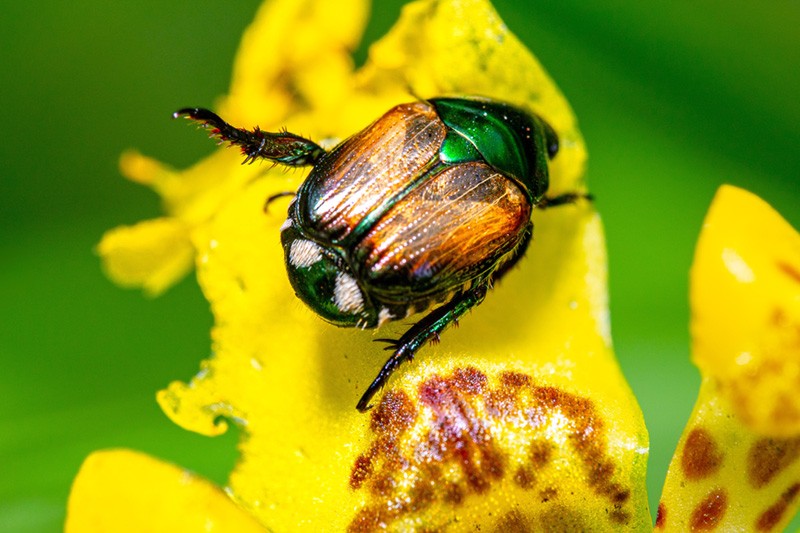
The Japanese beetle belongs to the scarab beetle family, which also includes cockchafers, summer chafers and garden chafers. It is approx. 8–12 mm long and looks similar to our native garden chafer. The Japanese beetle has a shiny green head.
Key identifying feature: five clearly visible white tufts of hair on each side of the body and two on the last body segment. Its larvae are typical grubs and are difficult to distinguish from those of other species.
How can Japanese beetles be controlled?
Traps with a specific attractant have been developed to catch the adult beetles. Far more important, however, is to control the larvae in the soil in order to interrupt reproduction for the long term. The 2nd and 3rd larval stages of the Japanese beetle can be controlled very well with nematodes of the species Heterorhabditis bacteriophora. Japanese beetles prefer to lay their eggs in moist lawns. In August and September the larvae are then at the right development stages and can be controlled by the nematodes.
To control Japanese beetle larvae we recommend our product nema-green®.
How does the Japanese beetle develop?
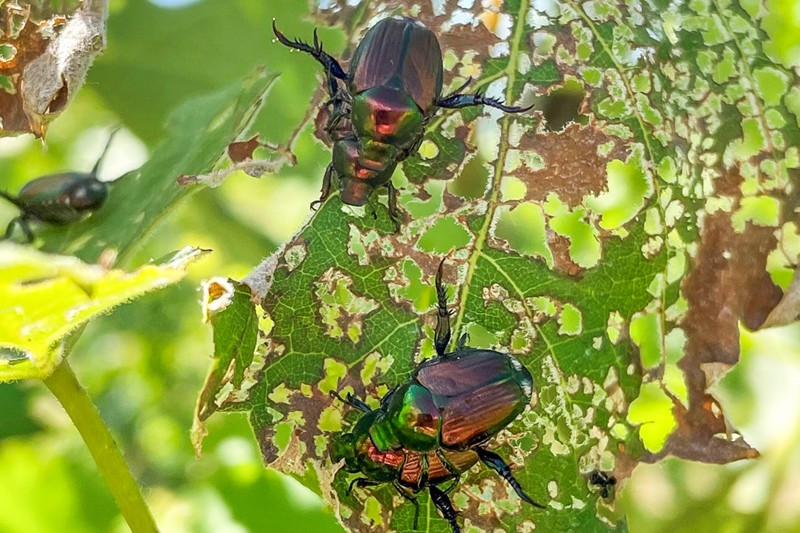
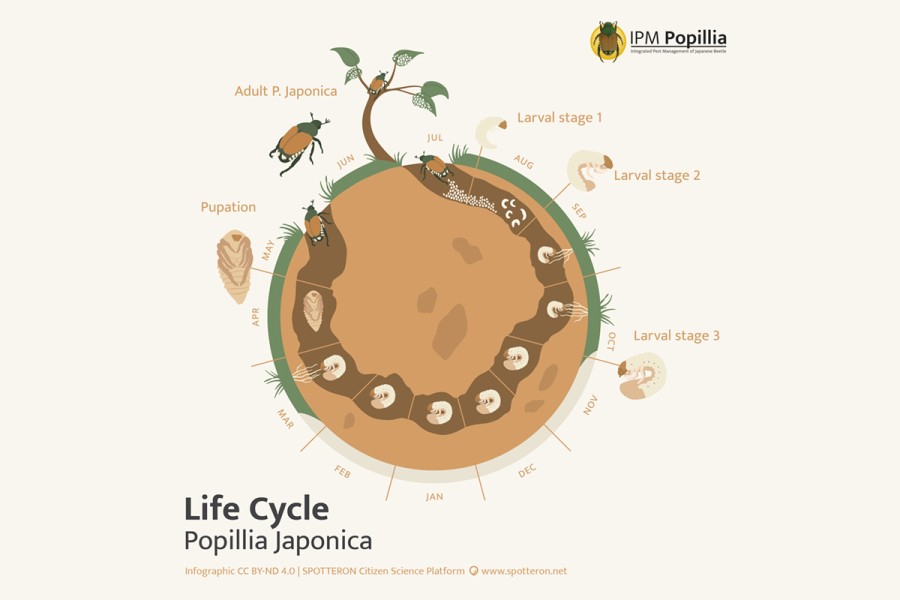
The Japanese beetle produces one generation per year and spends almost all of that time hidden in the soil. The adult beetles fly from roughly June to August and feed on leaves, flowers and fruit. During this time the females lay their eggs in the soil. After about two weeks the first grubs hatch.
By autumn the larvae grow through three stages and feed on grass roots. When it gets colder, they retreat to deeper soil layers and overwinter there. In spring they move back up, feed on the roots again and pupate from May onwards. A few weeks later the next generation of beetles emerges.

Are nematodes against Japanese beetles dangerous?
No. The nematodes used enable biological control of Japanese beetles and are harmless to people and pets.

Safe and effective
Nematodes are the natural solution against fungus gnats. The tiny roundworms control the larvae completely biologically and effectively. No chemicals, no side effects.

Service and advice
We have been producing and selling nematodes for biological plant protection for more than 25 years. Do you have questions? We have the answers!

Controlled quality
Every production batch is carefully checked and tested for quality. We only sell what really works.